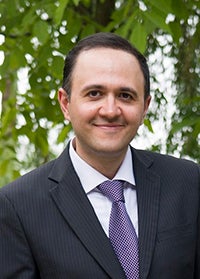
Dr. Alex Vadati

Dr. Ali Vahdati

Assistant Professor
Office: 4214 Ross Hall
Phone: (252) 737-7779
E-mail: vahdatia18@ecu.edu

Teaching Interests

Dr. Vadati’s teaching interests are in the areas of biomedical engineering and mechanical engineering. Examples include

  • Nonlinear solid mechanics,
  • biomechanics and mechanobiology,
  • finite element analysis,
  • computational modeling techniques,
  • tissue engineering,
  • cell mechanics,
  • continuum mechanics
  • physiological systems and modeling

Research Interests

Dr. Vadati’s research is highly interdisciplinary and utilizes multi-scale and multi-physics computational modeling techniques combined with experimental characterization and imaging of biological and advanced materials. His past research experience includes design and analysis of novel medical devices while working for a Fortune 500 medical device company, and design and predictive modeling of personalized surgical techniques at the Cleveland Clinic, Ohio, and KU Leuven, Belgium.

Federal Science Leadership Through NSF Rotator Service

Dr. Vadati has been on loan from ECU to the National Science Foundation (NSF) since January 2025. Serving as a rotator under the Intergovernmental Personnel Act (IPA) is one of the most prestigious opportunities available to academic faculty.

These positions allow professors to move from being applicants to “architects” of federal science policy, directly overseeing NSF’s “gold standard” merit-review process and recommending which transformative research receives funding. Beyond the high visibility within the national scientific community, the professional benefits are significant: rotators gain an insider’s understanding of the federal funding landscape, including what differentiates a winning proposal from one that is nearly funded.

The IPA mechanism is designed to be seamless for faculty. Rotators remain employees of their home institutions, retaining salary, seniority, and benefits while NSF reimburses the university for their time. through the Independent Research/Development (IR/D) program, they may devote up to 20% of their effort to maintaining their research labs and supervising graduate students, ensuring continued academic progress. When they return to campus, faculty bring back expanded leadership experience, a broad network of federal and industrial collaborators, and a deep understanding of the proposal review process— assets that strengthen their departments and enhance institutional competitiveness in securing future federal grants.

Vadati Lab Website:  Multi-disciplinary Mechanics and Modeling Laboratory (M3L)

Back to Faculty and Staff

Back to top